
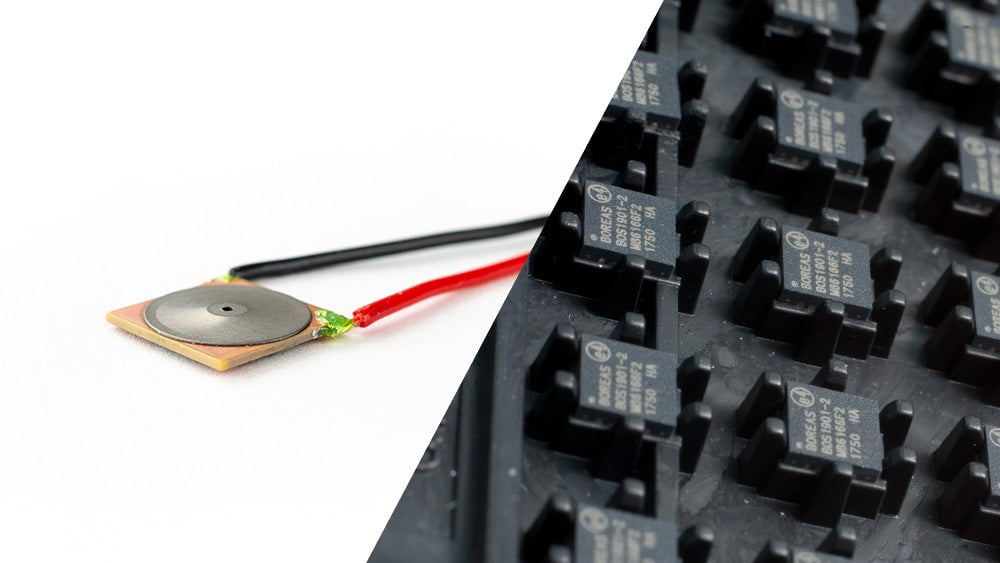
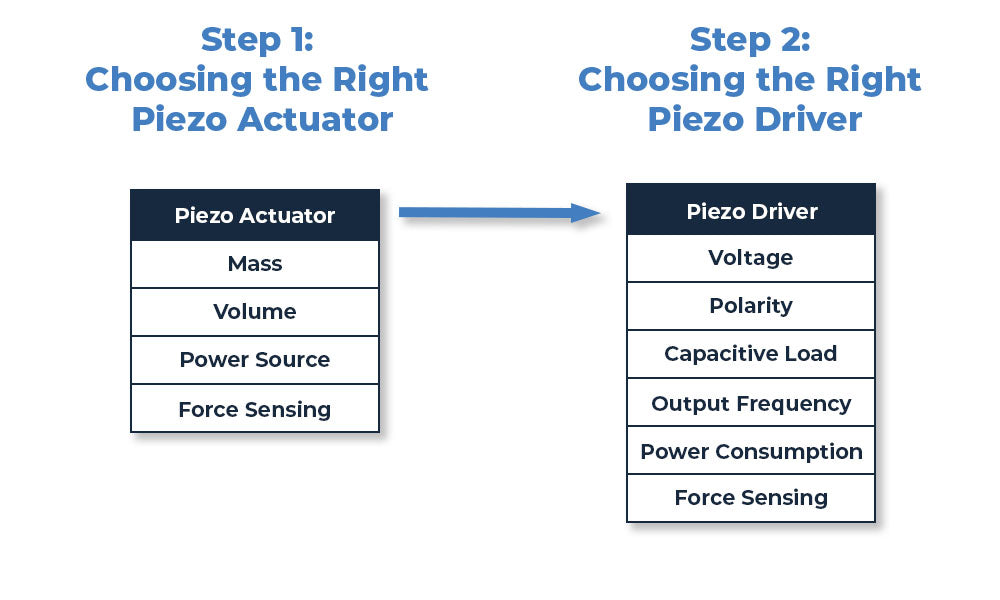
A piezo haptic solution is two components that have to be chosen together: the actuator, which produces the movement, and the driver, which amplifies the voltage and controls it. Choose one without the other in mind and the result underperforms, however good either part is on its own. This article covers the four questions that determine your actuator, namely the mass you are moving, the volume available, your power source and whether you need force sensing, then the five specifications that follow from that choice to determine your driver: output voltage, polarity, capacitive load, output frequency bandwidth and power consumption.
Key Takeaways
- A piezo haptic solution is an actuator plus a driver, and the two are chosen in that order. The actuator's specifications are what drive the driver selection.
- Four questions pick the actuator: what mass are you moving, how much volume do you have, what is your power source, and do you need force sensing.
- Feedback strength follows F = ma. A small mass such as a smartphone button reaches high acceleration with a lower-force actuator, while a large mass such as an automotive display needs a higher-force actuator for the same result.
- Piezo actuators need high voltage, which is the driver's job to supply. Check that your power source can feed it: a mobile battery and an automotive alternator are not equivalent.
- Five specifications then pick the driver: output voltage, polarity, capacitive load, output frequency bandwidth and power consumption. A bipolar driver will run a unipolar actuator, but not the other way round.
- Because the piezoelectric effect is reversible, the same actuator can sense force. A CapDrive® driver reads that signal, so one IC covers both sensing and feedback and can replace separate sensing hardware.
Selecting the proper hardware is crucial in a piezo haptic solution. The solution is composed of a piezo actuator and a piezo haptic driver, or amplifier. The two are deeply connected and rely on each other to deliver the best tactile feedback, so selecting the right components matters if you want the best possible result.
To help you find the right combination, here are the technical specifications that are relevant when choosing each component. This decision will involve several people on your team: product designers, mechanical engineers and electrical engineers all contribute to analyzing and selecting the piezo haptic components. Let's start with the first step, choosing the actuator.

Selecting the Proper Piezo Haptic Actuator
The product you are designing has a significant impact on which piezo haptic actuator and driver combination you can use. There are several factors to weigh, because integrating piezo haptics in a smartphone differs substantially from adding haptics to an automotive display. Four questions will get you to the right actuator:
- What is the mass you are trying to move?
- How much volume or space is available?
- What is the power source?
- Do you need force sensing in your product?
1. Mass
The first thing to consider is the force requirement, and feedback strength is governed by Isaac Newton's laws of motion. You can read more about the mechanical fundamentals of piezo haptic actuators here.
Newton's second law tells us that the sum of the forces F on an object equals the mass m of that object multiplied by its acceleration a: F = ma, assuming the mass m is constant.
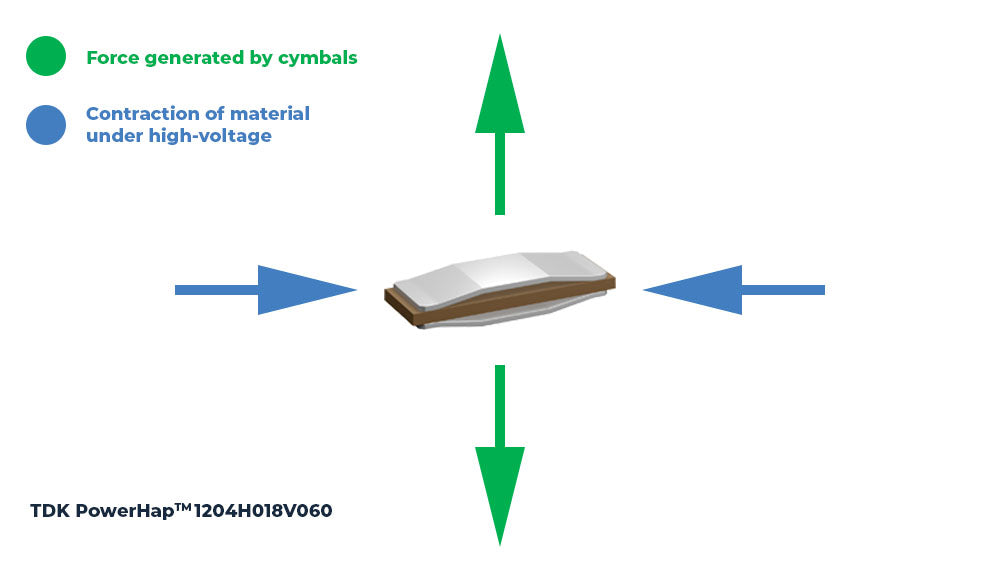
The piezo actuator's job is to generate acceleration. What you need to determine is the mass it has to move. If that mass is small, as when replacing a button in a smartphone, you can reach high acceleration with a lower-force actuator measured in newtons. If you are moving a large, heavy automotive infotainment display, you will need a higher-force actuator to reach the same acceleration and the same tactile feedback.
For any given actuator, a higher mass will limit the maximum achievable acceleration.
2. Volume
The second thing to determine is the actual volume available to fit the component into your product. Piezo actuators come in different shapes and can create force along different axes.
You need to know how much space you can allocate to the actuator, and which axis you will use to create the vibration you want.
This again depends on your application and on the type of tactile effect you are aiming for. You may have to adapt your design around the actuator, so it is best to have a clear idea early on of which type you are likely to use.
3. Power Source
Another critical consideration is your product's power source. Piezo haptics requires high voltage to work, which is precisely why you need a piezo driver: it controls the actuator and amplifies the power source up to the necessary high voltage. You therefore need to know your power source well enough to be sure it can feed the driver. A mobile device battery does not offer the same power levels as an automotive alternator. Piezo drivers are designed within those parameters and will not work on every power source, so select accordingly.
4. Force Sensing
Thanks to the reversible piezoelectric effect, piezo actuators can also serve as force sensors, because piezo material generates an electric charge when it is deformed. Applications where feedback is triggered by user input, such as button replacement, can make excellent use of this.
With those four answers you have what you need to select the actuator. Keep its technical requirements close at hand, because they are what will guide your driver selection.
Selecting the Right Piezo Haptic Driver
Your actuator leads the driver selection. A piezo driver has two main jobs: amplify the voltage from your power source, and control the actuator. The actuator specifications that matter here are the required output voltage, the polarity, the capacitive load and the output bandwidth.
1. Voltage
The piezoelectric effect is the interaction between mechanical and electrical potential in crystalline materials. Applying voltage across a piezoelectric material changes the crystals' electric polarization and produces mechanical deformation, so the material expands or contracts.
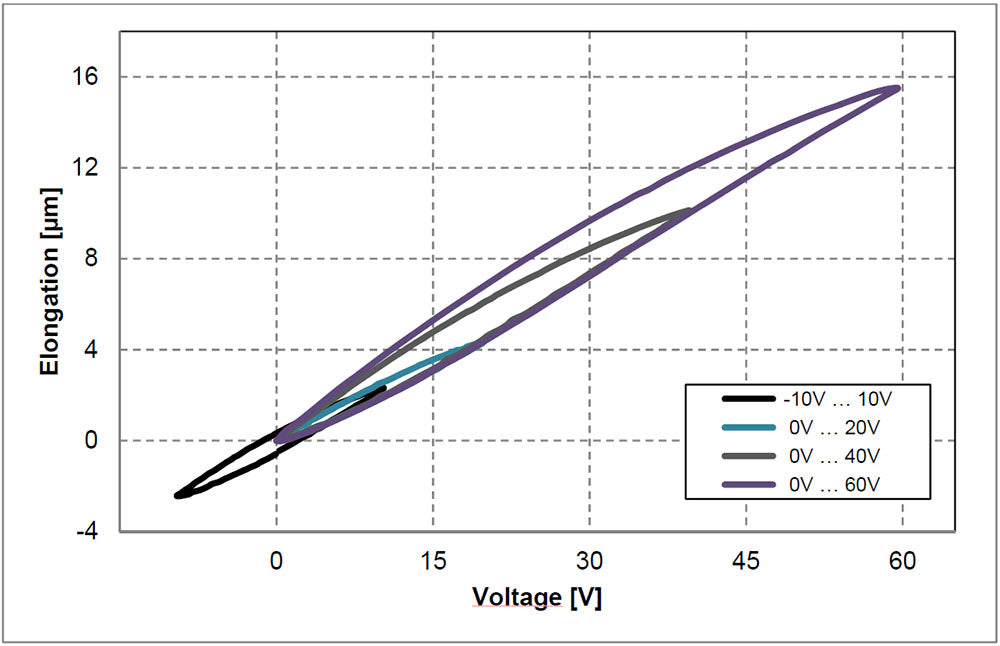
TDK PowerHap™ 0904H014V060 elongation measured between cymbal end-caps as a function of voltage. Source: 0904H014V060 datasheet.
The actuator's mechanical movement is the result of the electric field applied through the material, so respecting the minimum voltage requirement matters. Supplying less than the required voltage produces less material movement and weaker feedback.
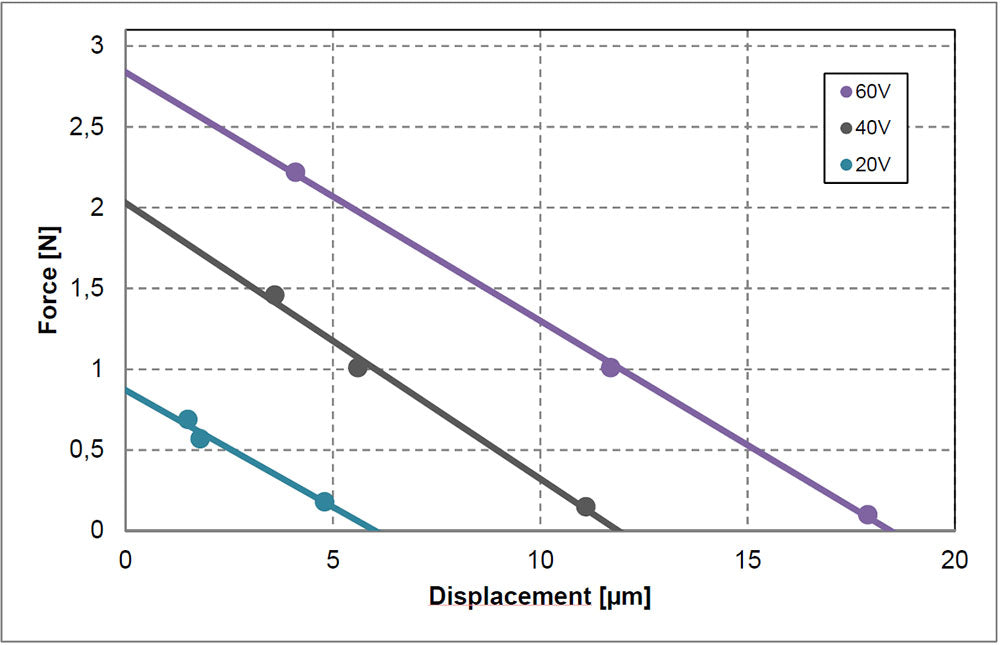
TDK PowerHap™ 0904H014V060 force-stroke diagram with different load springs, typical stiffness 150 N/mm. Source: 0904H014V060 datasheet.
2. Polarity
Staying with material polarity, you need to be careful when selecting a driver. Some actuators are bipolar, meaning they can sustain waveforms with both positive and negative amplitudes. Others are unipolar and work only with positive voltage waveforms.
Our BOS1921 piezo driver is bipolar and drives 190 volts peak to peak, meaning +95 V and -95 V.
You need to know your actuator's polarity to select a driver that will work with it. As a general rule a bipolar driver will run a unipolar actuator, but the reverse is not true.
3. Capacitive Load
Piezo actuators have inherent capacitance, meaning they behave electrically like a capacitor. Typically ranging from a few nF to a few µF for haptic actuators, that capacitance determines how much energy is needed to create a voltage large enough to induce the strain that produces vibration.
A higher capacitive load requires more power to charge quickly, so make sure your driver supports the actuator's capacitance.
4. Output Frequency Bandwidth
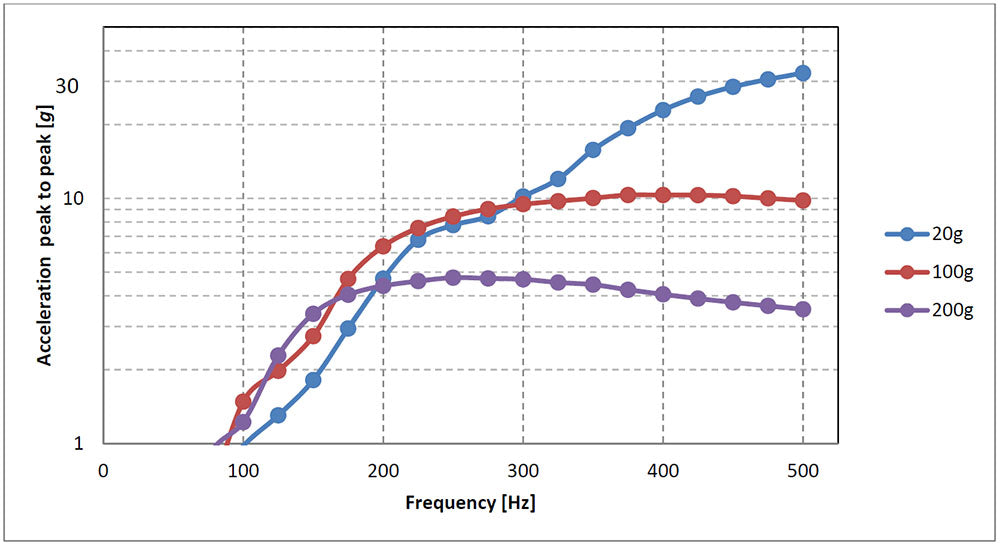
TDK PowerHap™ 0904H014V060 peak-to-peak acceleration as a function of frequency for different loads. Source: 0904H014V060 datasheet.
Frequency plays a significant role in haptic quality, for three reasons:
- A higher frequency generally means higher acceleration and a stronger perceived effect for a given sense receptor.
- Our somatosensory system uses different receptors depending on the vibration's frequency. Depending on the tactile effect you are aiming for, you need to work in the frequency range that matches the right touch receptor.
- The natural resonance frequency of the mass you are moving. Natural resonance is the frequency at which that mass resonates, meaning its displacement is amplified to its maximum. A lower mass raises the natural frequency and a higher mass lowers it. This matters most for applications built around continuous vibration.
Piezo actuators have a wide frequency bandwidth, meaning they can vibrate across a continuous range. You need a driver that can deliver the maximum required frequency at the actuator's capacitance and maximum voltage, so the actuator reaches its highest acceleration performance.
5. Power Consumption
Power consumption is not related to the quality of the actuator's feedback, but it is still a significant factor in choosing a driver. High power consumption drains the device battery and generates excess heat, which can limit functionality or become a hazard for the system.
Not all piezo drivers are power-efficient. Earlier piezo driver technologies used inefficient architectures to amplify voltage and generate high-voltage waveforms, and they were power hogs. The Boréas CapDrive® architecture works differently: it recovers the energy stored in the actuator's internal capacitance and reuses it rather than draining it from the battery. That lets our drivers use less than one tenth of the power of other piezo drivers on the market, and avoids overheating issues.
Bonus: CapDrive® Exclusive Force Sensing
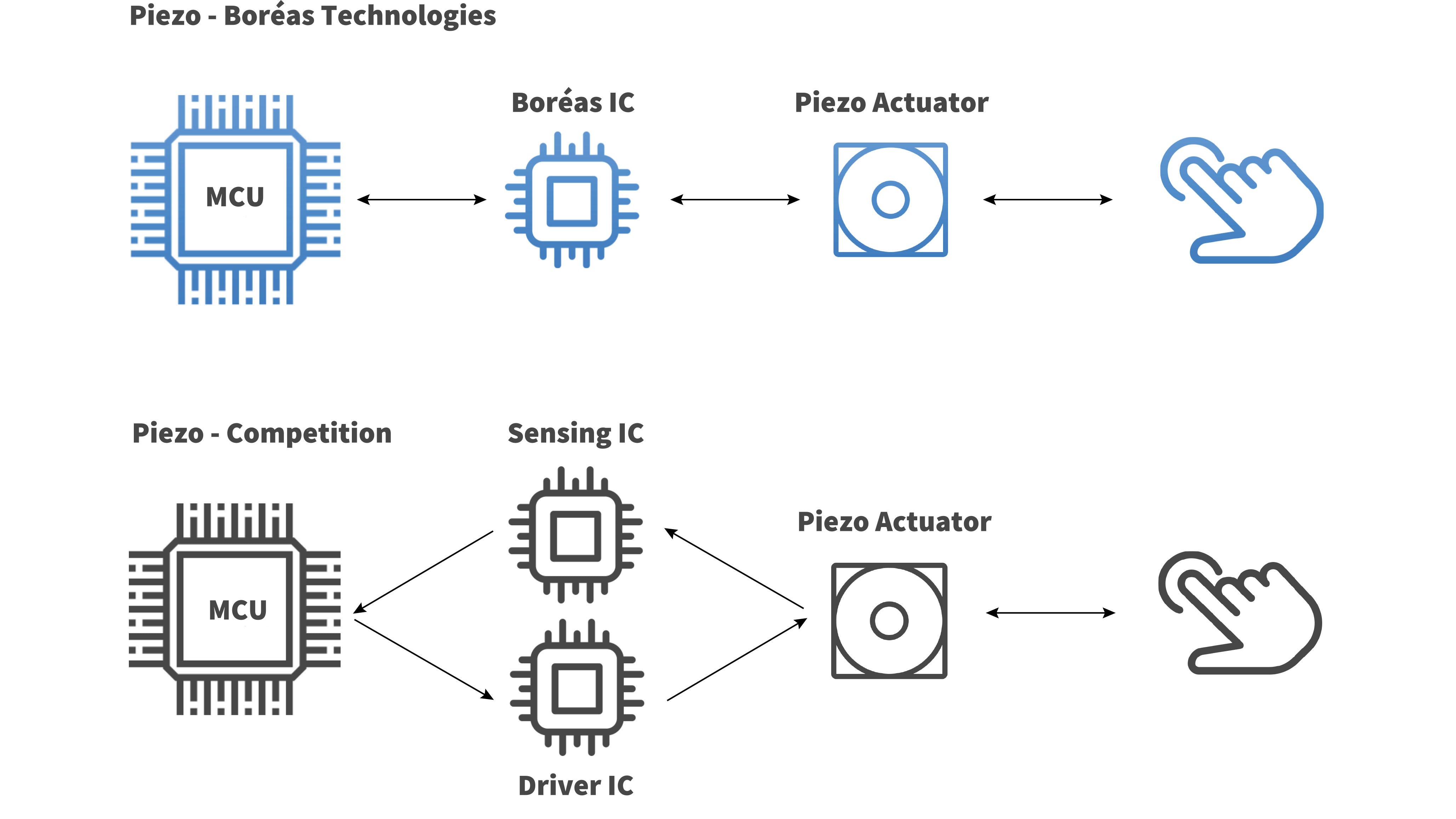
Another advantage of CapDrive® technology is the driver's ability to sense the pressure applied to the piezo actuator. Because the piezoelectric effect is reversible, the actuator generates a voltage when mechanical stress is applied to it. CapDrive® drivers detect that voltage change, which allows a single IC to handle both sensing and haptic feedback. Depending on your application and how the actuator is integrated, that may let you remove the separate sensing hardware from your design entirely.

Frequently asked questions
What do you need to know to choose a piezo haptic actuator?
Four things. What mass the actuator has to move, since that sets the force requirement. How much volume you can give it, and along which axis it needs to create force. What your power source is, because the driver has to be able to amplify it to the voltage the actuator needs. And whether the application requires force sensing, which changes what the actuator and driver together have to support.
How do I know what force my piezo actuator needs?
Work back from the mass. Feedback strength follows Newton's second law, F = ma, so the force you need depends on the mass you are moving and the acceleration you want from it. Replacing a button in a smartphone involves a small mass and reaches high acceleration with a relatively low-force actuator. Moving a large automotive infotainment display needs a much higher-force actuator for the same perceived feedback. For any given actuator, adding mass lowers the maximum acceleration you can achieve.
What is the difference between a unipolar and a bipolar piezo driver?
A bipolar driver can produce waveforms with both positive and negative amplitudes, while a unipolar driver works only with positive voltage. The practical rule is that a bipolar driver will run a unipolar actuator, but a unipolar driver cannot properly run a bipolar one. The Boréas BOS1921, for example, is bipolar and delivers 190 volts peak to peak, +95 V and -95 V.
Why do piezo actuators need high voltage?
Because the movement comes from the electric field applied across the piezoelectric material. Applying voltage changes the crystals' electric polarization, which makes the material expand or contract. A larger field produces more deformation, so supplying less than the actuator's specified voltage results in less movement and weaker feedback. Generating that high voltage from a low-voltage power source is the piezo driver's core job.
What is capacitive load and why does it matter when choosing a piezo driver?
A piezo actuator behaves electrically like a capacitor, typically somewhere between a few nF and a few µF for haptic actuators. That capacitance sets how much energy is needed to build the voltage that strains the material enough to vibrate. A higher capacitive load needs more power to charge quickly, so the driver has to be rated for the actuator's capacitance or the effect will fall short of what the actuator can do.
Can a piezo actuator be used as a force sensor?
Yes, because the piezoelectric effect is reversible. The material generates an electric charge when it is deformed, so pressing on the actuator produces a measurable voltage. A CapDrive®-based driver detects that change, which means one IC can handle sensing and feedback through the same actuator. For an application such as button replacement, that can remove the separate sensing hardware from the design.
Why does piezo driver power consumption matter?
For two reasons beyond battery life. A power-hungry driver drains the device battery, and it generates excess heat that can limit functionality or become a hazard for the system. Older piezo driver architectures were notably inefficient at generating high-voltage waveforms. CapDrive® recovers the energy stored in the actuator's capacitance and reuses it rather than dissipating it, which is what brings consumption down to less than a tenth of other piezo drivers on the market.
Glossary
Piezo actuator: A component that changes shape when a voltage is applied, converting electrical energy into the mechanical movement that produces tactile feedback.
Piezo driver: The integrated circuit that amplifies a low-voltage power source to the high voltage a piezo actuator needs, and controls the waveform it plays.
Capacitive load: The inherent capacitance of a piezo actuator, typically a few nF to a few µF, which determines how much energy is needed to drive it.
Bipolar driver: A driver able to produce waveforms with both positive and negative amplitudes. It can run a unipolar actuator; a unipolar driver cannot run a bipolar one.
Unipolar driver: A driver that works only with positive voltage waveforms.
Peak-to-peak voltage (Vpp): The full span between the most positive and most negative points of a waveform. The BOS1921 delivers 190 Vpp, meaning +95 V to -95 V.
Output frequency bandwidth: The range of frequencies a driver can deliver at a given capacitance and voltage, which caps the variety of effects an actuator can render.
Natural resonance frequency: The frequency at which the mass being moved resonates, amplifying its displacement to the maximum. A lower mass raises it, a higher mass lowers it.
Reversible piezoelectric effect: The property by which a piezo material both deforms under an applied voltage and generates a voltage when deformed, which is what makes force sensing possible through the same actuator.
CapDrive®: Boréas' piezo driver architecture that recovers energy from the actuator's capacitance on every cycle, enabling high-definition haptics at low power and integrated force sensing.
Related reading
Mechanical Fundamentals of Piezo Haptic Actuators
How to Choose a Haptic Actuator: Piezo vs LRA vs ERM
Piezo vs LRA: How Linear Resonant Actuators Compare to Piezo Haptics
Haptics in Wearables: Why Small Actuators Make Your Device Feel Cheap
Piezo vs. LRA Haptic Computer Trackpads: Which Technology Should You Select?
Boréas Blueprint: piezo integration engineering
Next steps
Review the CapDrive® piezo driver architecture → https://www.boreas.ca/pages/capdrive-technology
See the BOS1921 piezo driver specifications → https://www.boreas.ca/collections/piezo-haptic-drivers/products/bos1921-piezo-driver
Test a driver and actuator pairing with a development kit → https://www.boreas.ca/products/bos1921-kit-c01
Get help matching the combination to your product with the Boréas Blueprint → https://www.boreas.ca/pages/boreas-blueprint-engineering
Discuss your requirements with our applications engineering team → sales@boreas.ca
Leave a comment